In 2024, 43% of small businesses still don’t have a website. By 2025, they’ll collectively lose over $1.2 billion in missed revenue.
That’s not a guess—it’s a data-driven wake-up call. According to a 2024 Statista report, the gap between online-ready businesses and offline holdouts is widening faster than ever. In a world moving toward AI-driven search, voice-first shopping, and algorithm-controlled discovery, your website isn’t just a nice-to-have. It’s a non-negotiable asset.
And yet, nearly 1 in 2 small businesses still rely entirely on social media or word-of-mouth to get discovered. The hard truth? That strategy won’t survive 2025.
Here are five powerful, research-backed reasons why your business absolutely needs a website in 2025.
1. Google’s AI Search Will Bury Businesses Without Websites
If you haven’t heard of AI Overviews, you’re about to. Google is rolling out generative AI search results that scrape website content and summarize answers for users—right on the search page.
BrightEdge’s 2024 study found that businesses with optimized websites receive 3.2x more visibility in AI-generated search snippets.
These AI summaries heavily favor structured content from websites, not social media pages. If your business isn’t contributing structured content to the web, Google has nothing to quote.
Real Example:
Search “best local bakery for gluten-free cakes” and the first result isn’t a link—it’s a full answer sourced from a bakery’s FAQ page.
Actionable Tip:
- Register your Google Business Profile if you haven’t already.
- Optimize your website with clean HTML headers, meta descriptions, and FAQ schema to get picked up by AI.
2. Websites Are Your Only Owned Marketing Asset
Social platforms? Rented space. You don’t own your Instagram followers or your TikTok reach. Algorithms change, bans happen, and updates throttle your visibility overnight.
Case Study:
A plumber in Lagos built an audience of 5,000 followers on Instagram. One day, his account was flagged and shadowbanned—no appeal, no warning. But he kept getting leads from his website, which he had set up months prior. The website had booking forms, testimonials, and SEO working for him 24/7.
Platforms You Rent vs. Assets You Own
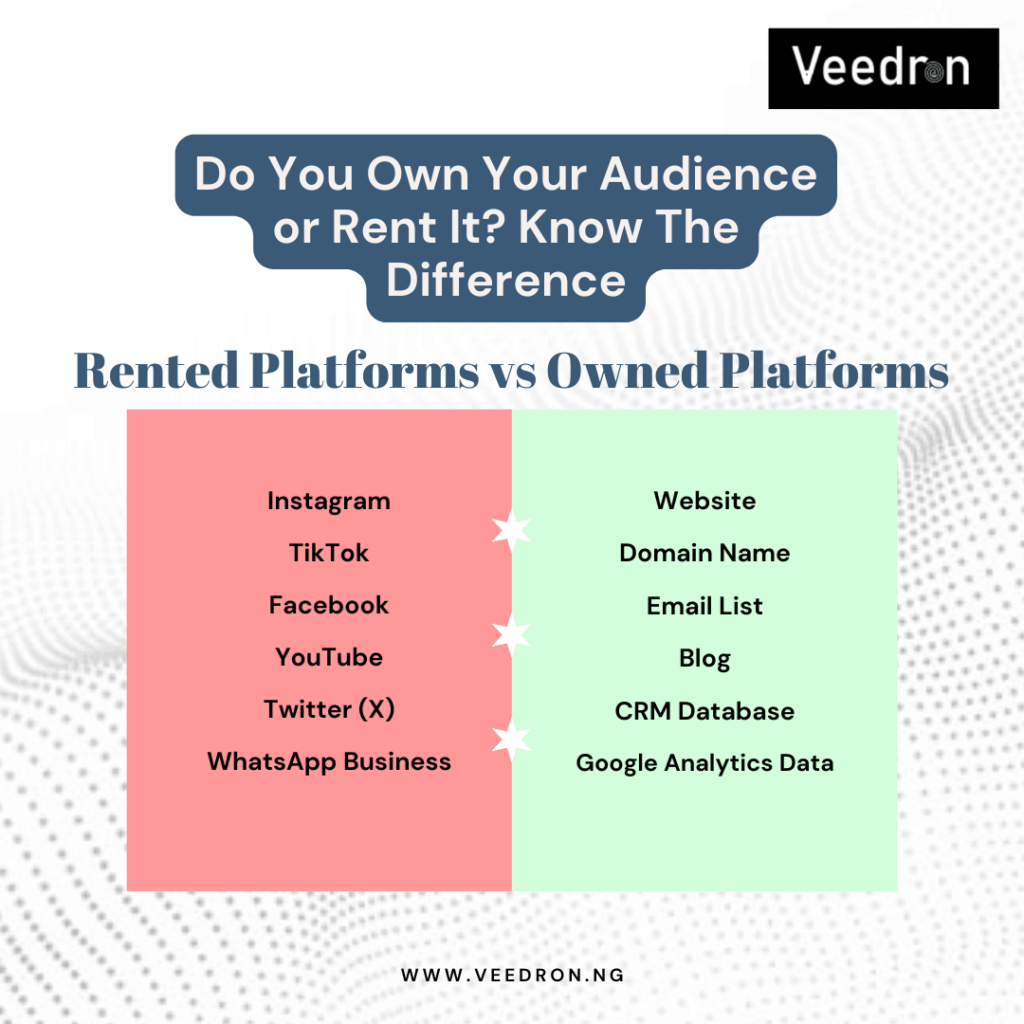
Pro Tip: Embed your Instagram feed into your website—connect the two, but own the center.
3. Voice Search Will Favor Websites in 2025
According to Semrush (2024), 52% of voice search answers are sourced from website FAQ pages. Not social posts. Not YouTube. Websites.
By 2025, voice-first devices (Alexa, Siri, Google Assistant) are expected to drive 30% of local business discovery, especially in urban areas (Gartner, 2024).
If someone says, “Find a nearby hair stylist open now,” the assistant pulls info from websites with local schema, opening hours, and service details.
Prediction:
Google will give priority to businesses with clean, structured data—starting with schema markup.
Action Step: Add this snippet to your website’s head:
{
“@context”: “https://schema.org”,
“@type”: “LocalBusiness”,
“name”: “Veedron”,
“address”: {
“streetAddress”: “12 Tech Ave”,
“addressLocality”: “Lagos”,
“addressCountry”: “NG”
},
“openingHours”: “Mo-Sa 09:00-18:00”,
“url”: “https://veedron.ng”
}
4. Websites Unlock AI-Powered Automation
You don’t need a massive budget to automate like the big guys. A simple, well-built website can connect to tools that:
- Book appointments through AI (like ChatGPT plugins or Calendly)
- Trigger invoicing via QuickBooks or Wave
- Auto-respond to FAQs via chat widgets
Stat:
According to McKinsey (2023), AI-powered small business websites lower operational costs by 40% on average due to reduced admin workload.
Example:
Using Zapier, a hair salon connected their website booking form to WhatsApp notifications, Google Calendar, and Stripe payments—saving 10+ hours/week.
5. Your Competitors Are Doing It Wrong (So You Can Win)
Most local business websites are… not great. Slow load times, no CTAs, outdated layouts.
Mini Audit:
3 local businesses near Ikeja (names blurred for privacy):
- Site A: 14 seconds load time, no mobile optimization
- Site B: Homepage has no phone number or contact form
- Site C: Auto-playing music and Flash animation (!)
Ahrefs data shows that improving just one factor (like page speed) can capture up to 30% of competitor traffic.
Opportunity:
You don’t need to outspend competitors—you just need to out-perform them on the basics.
“But What If…?” Common Objections
“I already have Facebook. Isn’t that enough?”
Not anymore. Reach is down 27% year-over-year (Meta Q1 Report, 2024). You’re competing with trending reels, ads, and cat videos.
“Websites are expensive.”
Wrong. Platforms like Wix ($23/month) or Webflow let you build fast, modern sites. Compare that to the hundreds of thousands in lost leads due to poor online visibility.
“I don’t know tech.”
You don’t have to. That’s why pros like us exist—and even DIY tools now use AI to guide you step-by-step.
Your 2025 Website Checklist (With Tools)
To thrive in the next year, make sure your site includes:
| Feature | Why It Matters | Tool |
| AI Chat Widget | Instant support & lead capture | Tidio, Drift |
| Local Schema Markup | Voice & AI visibility | TechnicalSEO.com Generator |
| Page Speed < 3s | Google ranking factor | Google PageSpeed Insights |
| Clear CTA | Boost conversions | Hotjar (to track clicks) |
| Mobile-First Design | 74% of users browse via mobile | BrowserStack, SEObility |
Final Word: You Can’t Afford to Wait
2025 isn’t the future. It’s now. Your customers are searching with their voices, getting answers from AI, and skipping platforms you don’t control.
A clean, optimized website is no longer a tech upgrade. It’s your business survival kit.
If you haven’t built your site yet, start today. And if you have one, audit it against this list.
Because while others chase the next algorithm, you can own the foundation.
Need help building or optimizing your small business website for 2025? Let’s talk.
Contact Veedron — We help businesses like yours grow smarter.